BATTLEMAP: The Marne, 1914
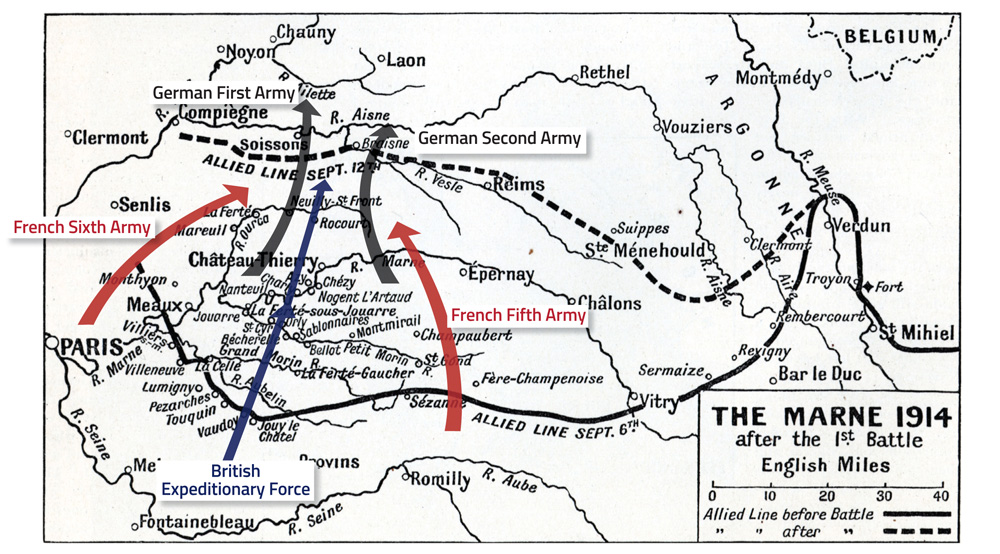
After the agony of weeks of retreating under a glaring sun, Sir John French’s British Expeditionary Force (BEF) turned wearily to assist the French armies in sealing victory at the Battle of the Marne. In the follow-up, the Allies sought to exploit their strategic success by hustling the beaten enemy backwards.
After four days’ pursuit, they found him standing at bay on the Chemin des Dames, a prominent chalk ridge just north of, and parallel to, the River Aisne. Over the next weeks, the opposing armies found themselves stalemated, as trench systems were dug deeper and deeper, and a new way of fighting established itself.
The Battle of the Marne completely unhinged the great German offensive and destroyed the invaders’ hope of winning the war by a killer-blow within six weeks. Indeed, the Germans felt obliged to fall back on supplies and reinforcements before beginning to contemplate any rekindling of the offensive. It also left the retreating German armies vulnerable to a counterstroke.
During the battle, the French had threatened to envelop the Germans’ western flank. A gap had opened up between von Kluck’s First Army and its neighbour, the south-facing Second Army under General Von Bülow, as the former turned west to face the flank threat.
It was to shove a wedge into this gap that Marshal Joffre, the French Commander-in-Chief, requested on 6 September that the BEF advance into it. Thus, the BEF would be arrayed between two French armies come the major assault on the Chemin des Dames a few days later.
In the haste of their manoeuvres, the German generals failed to close the gap. Although it was not clear to the Allies during the pursuit, this tantalising opening bobbed along in front of the BEF and remained in situ when the Germans finally turned to face their enemies and took up positions on the ridge above the Aisne.
The ‘Miracle of the Marne’ was a function of the way in which the German army of invasion spread out like a fan as it passed deeper into north-eastern France, until its western flank was in the air and a gap had opened between von Kluck’s and von Bülow’s armies. This was Joffre’s opportunity to counter-attack. The invaders were hurled back. But they rallied and dug in on the Chemin des Dames ridge, setting the stage for the first great trench-battle on the Western Front.
This is an extract from the full article featured in issue 50 of Military History Matters.