
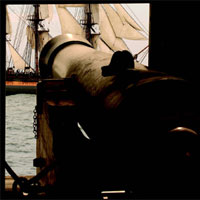
Broadside Cannon
There can have been few sights as frightful as the dull gaze of the 32 pounders of a ship’s broadside as it turned to face you.
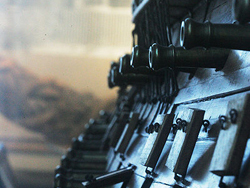
They were loaded with different types of shot depending on the type of damage they were intended to cause. Grape-shot would be sprayed in clusters along the length of the opposing ship to bring down large numbers of enemy personnel, while a plain 32-pound cannon ball was used to punch holes through the wooden walls of the enemy’s ship, sending shards of splinters flying like shrapnel through the lower decks. There was also bar-and-chain shot, which would be sent spinning through the air to slice the rigging or bring down masts. In an age when decisive manoeuvres were governed by the ficklest of wind changes, ripped sails or a fallen mast would leave you immobile and a sitting target.
Devastation
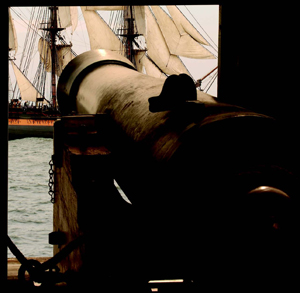
The cannon would fire either on the upward roll towards the enemy’s masts and rigging as favoured by the French, or on the down roll into the enemy’s hull as the Royal Navy preferred, sending deadly showers of wood splinters flying. An upward roll would be most likely to cripple a ship, whereas a downward roll would inflict the heaviest losses on the crew.
1759 saw the invention of the Carronade, a powerful short-range weapon affectionately nicknamed the ‘Smasher’. These light-weight cannon were mounted on a slide instead of a carriage and positioned on the forecastle or quarterdeck, where they provided supporting fire for the broadside cannon and augmented the ship’s short-range firepower. Although not originally counted in the numbering of a ship’s guns, the carronade, with its small crew and quicker reloading time, was a powerful addition to the force of a broadside.
Over the years, the accuracy and rate of fire of broadside cannon improved. By the early 1800s, the broadside had become a wall of weaponry to be greatly feared: a weapon of mass destruction that could reduce a mighty flagship to an underwater cemetery within hours.
Broadside Facts
• In 1812, Admiral Collingwood managed to train his crews in the Mediterranean to fire a broadside in a deadly record time of three and a half minutes.
• The demise of the broadside came about with the introduction of turret-mounted naval guns at the close of the 19th century.