Guy Fawkes - the real story behind the gunpowder plot
Remember Remember the Fifth of November
Gunpowder, Treason and Plot
Military History Matters discovers that Guy Fawkes, Britain’s most famous terrorist, cut his teeth as a professional mercenary in the pay of a foreign power.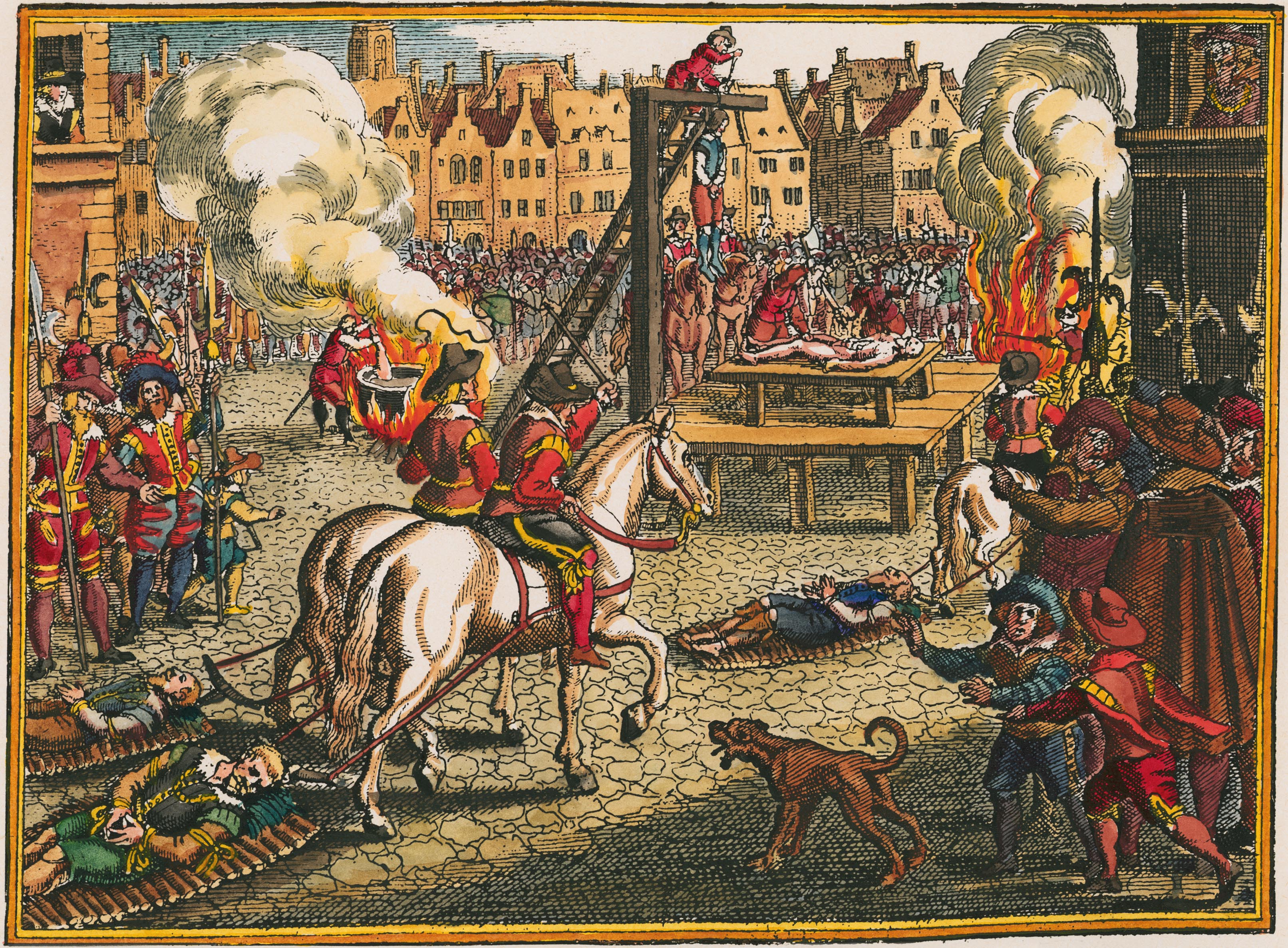
The gibbets were swinging with the carcasses of traitors the year that Guy Fawkes was born in the city of York.
Until 1570, the word of a Percy, a Neville, or a Dacre still counted for more in the North of England than that of a London-based queen – especially a Protestant queen. When the northern earls called out their dependants to fight for the Catholic faith, for Mary Queen of Scots, and for the overthrow of Elizabeth Tudor, some thousands of simple men, their retainers and tenants, answered the call.
But feudalism was dying in 16th century England, and many did not come. Outnumbered by loyalist forces, the northern earls retreated, and their armies dispersed with little fighting. The repression was ruthless nevertheless, and several hundred perished, suffering the monstrous penalty the law prescribed for traitors: execution by hanging, drawing, and quartering.
1570 was also the year Pope Pius V issued his fatwa against the English queen. The papal bull Regnans in Excelsis formally excommunicated Elizabeth Tudor and released her subjects from allegiance to her. The precise implications were much debated, but many took it to mean that she could, and should, be deposed, presumably by rebellion or assassination.
Rebellion had just failed. The northern earls had been rapidly and easily defeated. Henceforward, the strategy of England’s Catholic underground, ideologically fortified by the papal bull, would be a combination of terrorism and appeals for foreign support.
Young Guy Fawkes
Guy Fawkes’ father had been a Protestant, but he died when the boy was only eight. His mother was a Catholic, and she soon remarried a ‘recusant’ – a Catholic whose persistent refusal to attend Protestant service incurred the continuing attention of the law and regular fines or even imprisonment. He also attended St Peter’s School in York, a well-known centre of Catholicism. The previous headmaster had spent 20 years in prison for his recusancy, and the current head, while professing publicly to be a Protestant in order to keep his job, belonged to a well-known Catholic family.
When Guy Fawkes was a teenager, the developing struggle between the Catholic resistance and the Elizabethan state reached a climax. During the 1560s, an English Jesuit College had been set up in the city of Douai in the Spanish-controlled southern Netherlands. The Jesuits were a hard-line Catholic religious order – called by one eminent historian ‘the shock-troops of the Counter-Reformation’ – and Douai’s role was to educate young English Catholics, especially priests, and train them for dangerous underground missions in England.
The English Jesuit priesthood formed an illegal network of activists, operating secretly by moving between ‘safe-houses’, usually those of Catholic aristocrats or gentry, hiding in specially prepared priest-holes during raids by ‘poursuivants’ and constables. Nicholas Owen, a disabled craftsman and devout Catholic known as ‘Little John’, was famous in recusant circles for the dozens of hiding-places he had contrived across the Midlands.
Meantime, in the taverns and ‘ordinaries’ (eating-houses) of London, young Catholic gentry discussed sedition and hatched plots. Anthony Babington was one. Unfortunately for him, and for many others like him, he was being watched from the beginning.
Elizabeth’s secret police
Sir Francis Walsingham, effectively Elizabeth’s home secretary and head of the secret police, was operating a nationwide network of spies, informers, and agents provocateurs. He had tabs on virtually every active dissident. When Babington wrote a long letter to Mary Queen of Scots outlining his plan, Walsingham knew about it. But the wily Tudor policeman continued watching and waiting, seeking a bigger catch. Only when Mary replied, approving the plot, incriminating herself inextricably, did he pounce.
Babington and his accomplices perished on the scaffold in 1586. Mary, the Catholic heir to Elizabeth’s throne, was beheaded the following year. Then, in 1588, English cannon, fire-ships, and bad weather scattered the Spanish Armada and shattered any prospect that Catholicism would be restored by foreign invasion.
All Europe was racked by the titanic struggle between Protestant Reformation and Catholic Counter-Reformation. Protestantism was the religion of the new middle class of merchants, gentleman-farmers, yeomen, and master-artisans. Catholicism represented the old order. Its principal standard-bearer was Philip II’s Spain, 16th century Europe’s geopolitical colossus, with a vast, bullion-bearing empire in the Americas, and territories in Italy, Germany, and the Netherlands.
In 1593, Guy Fawkes left England to seek service under the Spanish Crown and the freedom to practise his faith without molestation. He travelled to the very epicentre of the global confrontation, the place where revolutionary Protestantism had been battling Spanish imperial domination for a generation. He went to the Netherlands to fight the Dutch.
The Dutch Revolt
In August and September 1566, a wave of revolution had swept across the Low Countries. For most of the next 40 years, war raged between Dutch Protestant rebels and Spanish Catholic forces. By rights, the revolutionary militias should have been no match for the imperial superpower, but geography and sociology supplied the radical cause with deep reserves of defensive resilience.
The Low Countries were densely populated and heavily urbanised. Of the 3 million Dutch – equal in number to the 3 million English across the Channel – fully half lived in towns. The landscape, especially the northern part (what is now Holland), was low-lying and dissected by countless dikes and embankments, canals and rivers. Most of the larger towns had modern defence-works, with low, thick, stone-revetted ramparts, projecting angle-bastions, and carefully engineered killing-zones. And each of these towns was defended by an ideologically-motivated Protestant population of what in England would be called ‘the middling sort’.
The Spanish poured tens of thousands of troops into the Low Countries. Sometimes their offensives brought the revolt close to collapse. In the mid 1580s, the area of rebel control was reduced to north-western Holland. But the intractability of the country, the gritty resistance of the Dutch militiamen, and the inability of the Spanish state to maintain the flow of funds needed to support such an expensive war always combined to prevent outright victory.
The Dutch were helped, too, by an ‘international brigade’ of foreign fighters. Just as Communists and Fascists across Europe regarded the Spanish Civil War of 1936-1939 as a critical struggle, so the Protestants and Catholics of the late 16th century saw the Dutch Revolt of 1566-1609 as the front-line of the Reformation. The flood of foreign support was fed by atrocity stories coming out of the Low Countries. When Antwerp was captured in November 1576, the ‘Spanish Fury’ unleashed by the victors lasted several days, destroyed 1,000 houses, and killed 8,000 people.
In 1584, fearful that the final collapse of the Dutch would deliver the Low Counties to Spain, Elizabeth I offered direct military support. Previously, Dutch exiles had found safe haven in English towns, many English volunteers had been recruited for the war, and Dutch ‘Sea Beggars’ – regarded as pirates by the Spanish – had sometimes been allowed to use English ports. But Spanish diplomatic pressure had kept Elizabeth lukewarm about all-out backing for the Dutch rebels. This changed in the mid 1580s: a small English army was dispatched, and, periodically reinforced, it played a continuing part in the war for some two decades.
The English in the Netherlands
Elizabeth’s Dutch war was no mere military footnote. On 2 July 1600, in a fierce battle on the beach at Nieuport, an Anglo-Dutch army defeated the supposedly invincible Spanish in open battle. The English contingent of 1,600 men under Horace Vere did the bulk of the fighting. Though they lost half their strength in killed and wounded, the Spanish lost 3,000 and were routed. ‘So ended the fight of Nieuport,’ reports Fortescue, the famous 19th century historian of the British Army, ‘the dying struggle of the once famous Spanish soldier, and the first great day of the new English infantry.’ When, the following year, 1,500 English reinforcements arrived from across the sea, they were ‘all dressed in red cassocks’. The redcoats had become a factor in European politics.
But for all their Protestant grit, the English soldiers were badly treated by a notoriously parsimonious government. Not only was funding inadequate, but both government departments and private contractors were corrupt, and the remuneration system involved a set of deductions for clothing, lodging, food, and other essentials that reduced annual pay from a nominal sum of almost £13 to barely £1. Discontent in the English ranks provided an audience for Catholic subversion. The ‘English Regiment’ that Guy Fawkes joined in the mid 1590s was a unit of turncoats fighting for Spain.
Though he was probably always a closet Catholic, Sir William Stanley, the English Regiment’s commanding officer, had been knighted for services to the English cause in Ireland in 1569, and had been commended by the Earl of Leicester for his courage at the Siege of Zutphen in Holland in 1586, when he was described as ‘a rare captain … worth his weight in pearl’. But the following year, Leicester’s ‘rare captain’ surrendered the fortress-town of Deventer to the Spanish and announced his change of allegiance and religion. That his men defected with him is probably testimony to their sense of grievance against Elizabeth’s regime.
Stanley’s English Regiment seems to have been – or rapidly became – a multi-national mercenary force of some 700 English, Irish, Welsh, Scots, Italians, Burgundians, and Walloons. Unfortunately for the turncoat soldiers, conditions of service did not improve: Philip II is reported to have said that he approved the handing over of Deventer but not the traitor who accomplished it, and Stanley’s officers were soon complaining of their impoverished condition in the Spanish service. Though the Regiment peaked at around 1,200 as English Catholic gentlemen rallied to it, numbers and morale later plummeted. It was a somewhat down-at-heel mercenary ragbag when Guy Fawkes joined, probably after 1596.
The Flanders connection
By this time, Stanley, whatever the state of his Regiment, was at the centre of the English Catholic espionage network. Fawkes was a willing and welcome recruit. Tall, handsome, and dashing, he was a first-class soldier, becoming first an ensign, then being recommended for a captaincy in 1603. More than that, he was a fanatic, a veritable soldier-monk whose clean living and religious devotions made him something rare among soldiers of his age, or indeed of any age. His deepening allegiance to the cause of Catholic counter-revolution was symbolised by a change of name: Guy Fawkes, the de-nationalised terrorist-in-the-making, Hispanicised his name to Guido.
As Stanley busied himself concocting yet another plot to assassinate the English queen and overturn the English Protestant state, Fawkes was dispatched to Spain to solicit Spanish military support. It was a forlorn mission. Crippled by the cost of the war and over-extended on other fronts, the Spanish Empire was seeking peace with England.
Not only were the tectonic plates of global geopolitics shifting. Greater wisdom informed Spanish assessments of English Protestantism’s durability. The succession of James I in 1603 – a Protestant succession achieved without a hitch – gave the lie to the hysterical memoranda submitted by Guido Fawkes and other members of the unofficial English Catholic delegation in the Spanish royal capital. The hardnosed men who advised the King simply did not believe wild claims to the effect that thousands of English Catholics were ready to rise against a tyrannical government at the signal of a foreign ruler. The Spanish would not move. The English Catholics were on their own.
James, eager to secure support prior to his accession, had given the impression that he would, as king, grant English Catholics greater tolerance, an impression bolstered by the fact that his wife, Anne of Denmark, was a Catholic.
It was not to be. The Catholic community contained a militant minority that was sympathetic to a foreign power and harboured a desire to overthrow the Protestant monarchy. In these circumstances, neither King nor Parliament could contemplate the dismantling of the anti-Catholic apparatus constructed in the previous reign. If there were any liberal-minded doubts, these were quickly dispelled by the Bye and Main Plots of 1604.
These two plots were hastily hatched, quickly betrayed, and easily crushed. But they set the stage for a far more serious endeavour in 1605, because they provoked heavy-handed repression by the state, and thereby finally dashed any remaining hopes English Catholics may have had of relief in the new reign. These events, in the view of leading English Jesuit Father Tesimond, were ‘the spurs’ that set the Gunpowder Plotters ‘upon that furious and fiery course which they afterwards fell into’.
A ‘furious and fiery course’
The charismatic inspiration and leadership was provided by Robert Catesby. Highly talented and ambitious, he was frustrated in life by his principled refusal to swear the Oath of Supremacy – which amounted, for Catholics, to a denial of the authority of the Pope and the Church – and consequent exclusion from public service. He seems to have experienced some sort of ‘born-again’ conversion to militant Catholicism in 1598, and thereafter was impervious to moderate counsel, including that of the leading English Jesuits, who feared the crippling repression likely to follow a terrorist outrage.
Catesby met with four others at the Duck and Drake in the Strand on Sunday 20 May 1604. The four were Tom Wintour, Jack Wright, Thomas Percy, and Guido Fawkes, the last now back in England after the failure of his unofficial diplomatic mission to the Spanish Court.
Catesby’s plan was shocking in its ruthlessness. There was to be ‘a stroke at the root’. The King, any other members of the royal family present, and the entire House of Lords were to be destroyed by a gigantic explosion at the opening of the new parliamentary session. What was to follow was more hazy, but the intention seems to have been a Catholic rising in the Midlands, where many of the conspirators had estates, and the installation of a new government, probably headed by Princess Elizabeth (daughter of the King), with a Catholic peer like the Earl of Northumberland as regent (the putative monarch being a minor and therefore mere figurehead).
Over the months, the conspiracy grew to number thirteen and the plan matured. The original five were joined by Robert Keyes, Thomas Bates, Robert Wintour, Kit Wright, John Grant, Ambrose Rookwood, Francis Tresham, and Everard Digby. Most were linked by kinship with others in the group, the only exceptions being Digby, Bates (who was Catesby’s servant), and Guido Fawkes himself.
A terrorist weapons-system
Gunpowder was purchased and stored in Catesby’s house in Lambeth, just across the Thames from Westminster. A lease was secured on a ‘cellar’ – in fact, a ground-floor storeroom – belonging to, and close to the house of , one John Whynniard. This storeroom was right in the heart of Westminster; in fact, it lay directly beneath the very chamber where the House of Lords met. Early 16th century Westminster was not a secure government enclave: alongside the official buildings was a warren of alleyways, houses, and business premises. In this respect, the execution of the Plot was simple.
Meantime, horses, muskets, and powder were assembled in the Midlands. The job of Guido Fawkes was to decapitate the English state. That of Catesby and most of the other conspirators was to raise the armed force that would then impose a new government.
All terrorist operations – like military operations more generally – depend upon access to an effective weapons-system. The Plotters had chosen gunpowder. Though subject to government control, enforcement was lax, and there was a glut of powder on the market because of the recent Anglo-Spanish peace. Completely stable unless ignited, gunpowder was easy to transport and safe to handle. A mix of sulphur, charcoal, and saltpetre, it was manufactured by a process that involved the addition of alcohol and water, followed by oven-drying, and then breaking into small crumbs known as ‘corned-powder’.
The main disadvantage was that over time gunpowder ‘decayed’, separating back into its component parts, rendering it inert even when fire was applied. This is precisely what happened to the conspirators’ first consignment, and they had to replace it with a second. Had the 36 barrels of powder they placed under the House of Lords exploded, they would almost certainly have reduced the building to rubble and killed everyone inside. It would have been a terrorist attack comparable in impact with 9/11. The Gunpowder Plot amounts to the most ambitious terrorist conspiracy in British history.
But the second consignment of powder, unknown to the conspirators, had also decayed well before the date of detonation. It hardly mattered. The government knew all about the Plot. Robert Cecil, James I’s leading minister, had inherited Francis Walsingham’s network of agents – and also his calculated use of prior intelligence to maximise the size of the terrorist bag. The conspirators went about their work under secret surveillance, but unhindered, thereby not only incriminating themselves and others, but also forging a propaganda weapon of immense value to government hardliners determined to crack down on Catholic dissent.
State terror
The government was quite safe. Cecil knew the powder under the Lords was decayed. Even had Guido Fawkes lit the powder fuse, the weapons system would have failed. In the event, he was arrested just before doing so, in the small hours of 5 November 1605, the day of the twice-postponed opening of the parliamentary session.
No-one was sure who exactly he was, and for a while he maintained his false identity as ‘John Johnson’. But a few days’ later, he was broken under torture. He may have survived what James, in his written authority, called ‘the gentler tortures’: the manacles, by which men were suspended for hours by the wrists. The weight of the body combined with tight metal clasps sometimes damaged the victims’ hands so severely that they were left permanently ruined.
If he did hold out, matters will have progressed to, as James put it, ‘the worst’. This was the rack, a bed-like contraption of rollers, levers, and ropes, by which the victim’s joints were gradually dislocated. Sessions could last as long as three hours. None, or very few, seem to have been able to endure for long.
Most of the other conspirators had escaped to the Midlands, but the planned rising never happened, and they soon found themselves hunted fugitives adrift in a sea of popular hostility. The common people were mainly Protestant, anti-Spanish, and loyal to the King. A group of 36 – conspirators and followers – were cornered and besieged at Holbeach House in Staffordshire on 8 November. Catesby, Percy, and the two Wright brothers were killed in the shoot-out. The others were taken. So were many more in the weeks following as the security forces hunted down known Catholic activists.
The bag eventually included Father Garnet, the Superior of the English Jesuits, who was taken at the end of an eight-day-long search of Hindlip House in Worcestershire. Hiding with another Jesuit in a tiny priest-hole with neither room to stretch out nor sanitary facilities of any kind, Garnet was eventually forced by the stench, filth, and extreme discomfort to give himself up to the search-party camped out in the house.
The state mounted a series of show-trials early in the New Year. Attorney-General Edward Coke delivered long, rabid, scaremongering denunciations of both the terrorists and the priests. All Catholics were suspect. All were potentially part of a vast underground network of treason and terror. The fact that the terrorists were a small minority, that the Jesuits had opposed the Gunpowder Plot, and that most Catholics had not risen in response to Catesby’s call was ignored.
Guido Fawkes, ‘weak with torture and sickness’, needed help climbing the ladder to the scaffold on 31 January 1606. But the old soldier found the strength to deny the executioner the full extremes of a traitor’s death. His fellow conspirators had been hanged, cut down while still alive, and then castrated and disembowelled, before finally being finished off by decapitation. Fawkes, ‘the great devil of all’, once the noose was fitted, managed to jump from the gallows and break his own neck.