MUSEUM - The Martyrs' Memorial and Museum, Jordan
John Winterburn finds a censored version of Jordan’s military history at the country’s national army museum.
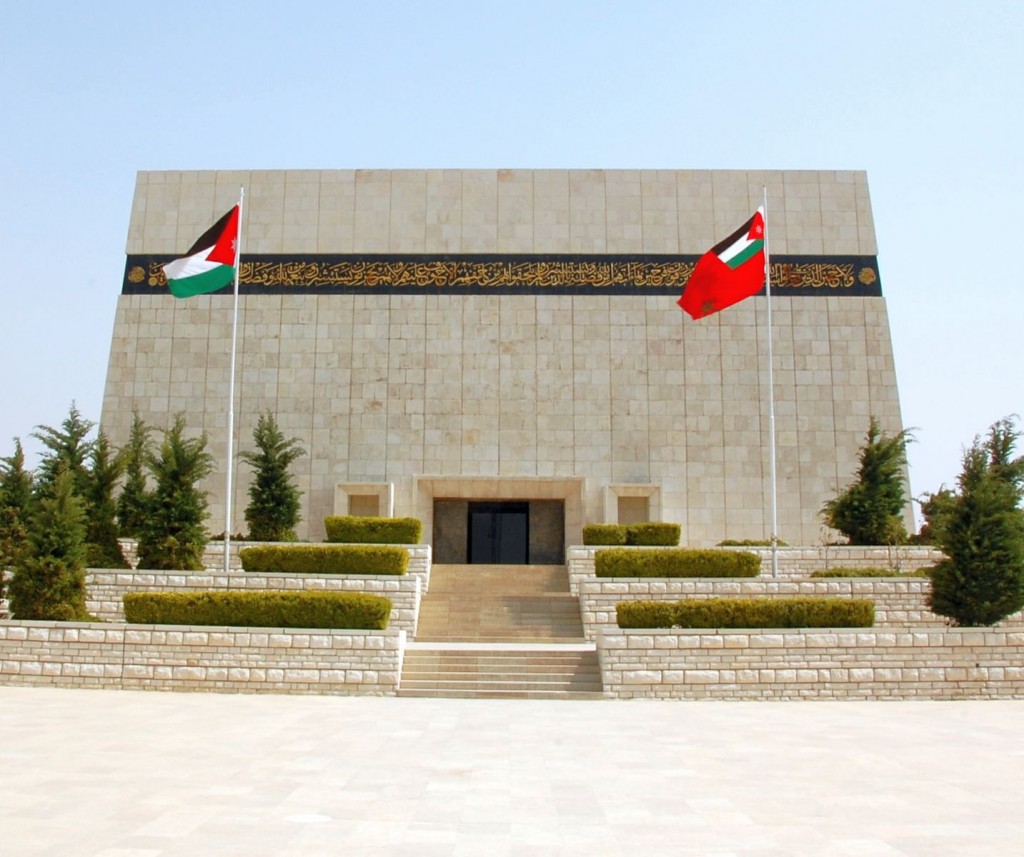
Sarh al-Shaheed, The Martyrs Memorial, sits like an acropolis on the hill overlooking the capital city, Amman. From the outside it is austere, presenting an almost featureless façade of gleaming white stone broken only by a band of polished black basalt inscribed with gold lettering; words from the Quran on the subject of martyrs and martyrdom.
In front of the building is a large forecourt, and two Long-Tom (155mm M1) field-guns are positioned pointing over the city on silent sentry duty, symbolically reinforcing the power and authority of the place and protecting the memory of the martyrs. The possibility that these guns may have been the ones to shell Tel Aviv and Jerusalem in Jordan’s disastrous participation in the 1967 Six Day War is forgotten here and never mentioned within the museum.
More than just a museum, the building is a memorial to those, The Martyrs, who gave their lives in the service of Jordan since 1915, a place where ‘the nation celebrates its victories and the state displays its history’, and honours the Hashemite dynasty in Jordan.
Built on the orders of the King Hussein bin Talal, the father of modern Jordan, it was designed by the Jordanian born architect Victor Adel Bisharat and inaugurated on 25 June 1977, a date that coincided with the 25th anniversary of nation building under the king. The design of the building means that visitors are shepherded ever-upwards, climbing to the higher levels of the museum. This carefully choreographed movement symbolises the transcendence of martyrs’ spirits. The building’s large interior space and external appearance are a style-reference the Ka’aba, the holiest place for Muslims, in Mecca.
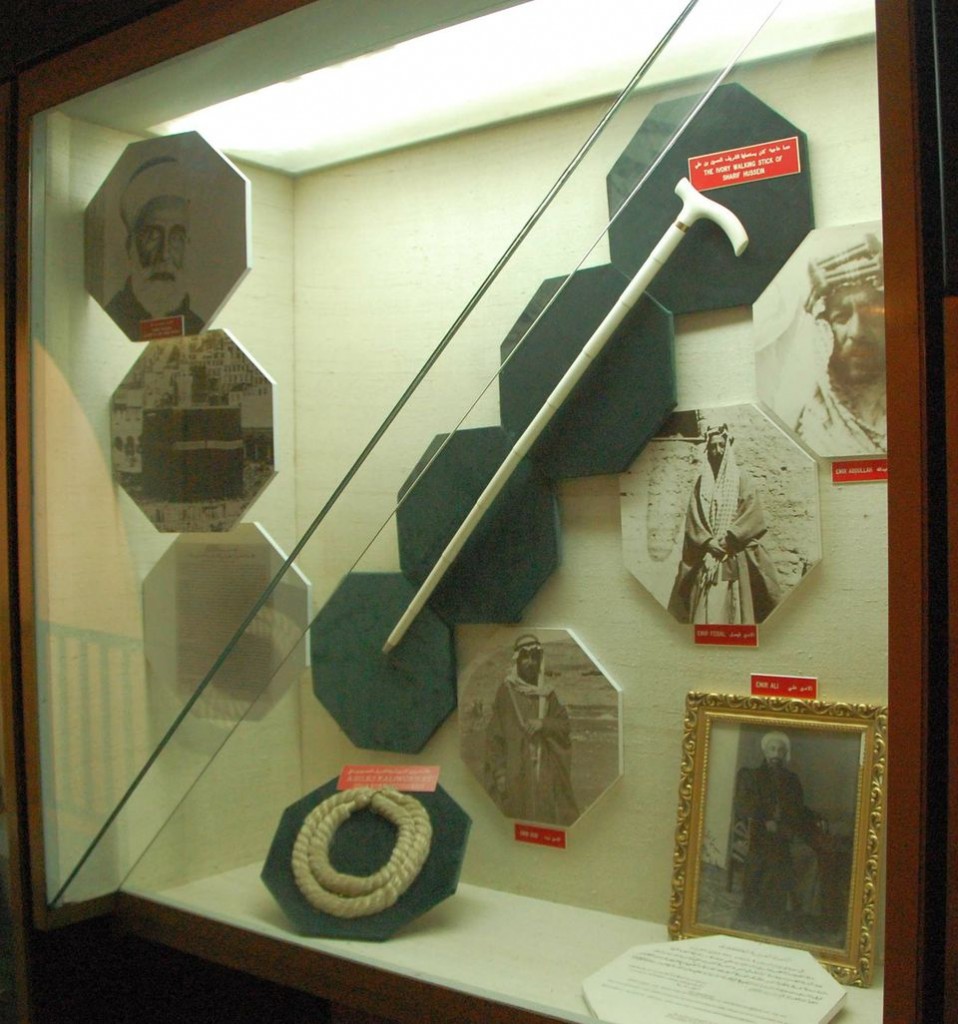
Sharif Hussein’s portrait is shown alongside some of his belongings including an ivory walking stick and the silk ikal, together with photographs of four of his sons, and images of the Ka’aba, reinforcing the Hashemite link with Mecca. There are exhibits of old weapons, including pistols and rifles used at the time of the revolt, beside which is a cabinet of photographs of the Turkish-held fortified garrison railway station complex at Ma’an which was attacked by Arab forces in April 1918. It was briefly taken but never held by the Arab forces during the revolt, a fact glossed over in the display which includes short sections of damaged railway track and explosives.
Continuing upward you pass other historic displays and head towards toward more contemporary exhibits. The cabinets hous curious agglomerations of Turkish uniform, British radio equipment, US-made weapons, groundsheets, signalling lamps, Turkish cavalry swords, and camel saddles together with photographs of Glubb Pasha and the Jordanian Army in the 1950s. One particularly interesting artefact is a complete copy of the Quran printed on a single sheet of paper; another reference to the importance of the Hashemite-Islamic heritage.
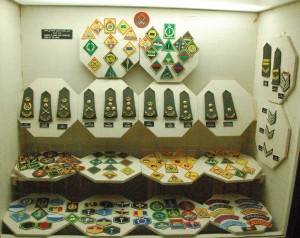
As the ramp ascends further, the cabinets show badges of rank and formation signs, and the honours medals awarded to the army. Several examples of uniforms are on view including one worn by the late King Hussein.
At the top of the building is a walled roof garden, but access is restricted by large glass panels. Itself like a large museum cabinet, this enclosed ceremonial space is for the privileged. At its centre stands a small olive tree; the tree of life and peace. Beside it sits a golden pitcher from which the King and visiting dignitaries can sprinkle water on the tree in a ritual that places the martyrs’ remembrance at the heart of the country’s military ceremonial. The public are able to stand and look through gold tinted glass doors, but are not permitted to touch, walk around, or read the black panels inscribed with the names of the martyrs.
The museum’s collections are limited and narrate a sanitised view of history, but the best exhibit is the building itself and its immediate environment. Looking at its design, position, and symbolism will leave you with an understanding of the importance of the country’s military and their Hashemite pedigree to the modern state of Jordan.
Further Information Sarh al-Shaheed, the Martyr’s Memorial, is located next to the Sports City Stadium, gate 4, in the Shmeisani district, 5 km northwest of Al-Balad (downtown), Amman. It is open everyday, 8am-4pm, and is closed Friday. Entry is free of charge. Tel. + 962 6 566 4240