The Diabolical Death Ray – Back To The Drawing Board
It seems mankind is always trying to invent ever more fiendish ways to wage war. One Holy Grail has been the attempt to develop a so-called ‘death ray’. Greek inventor Archimedes supposedly used a ‘burning mirror’ death ray against Roman ships during the Siege of Syracuse in 214-212 BC. If he did do so, it cannot have worked very well, because the Romans eventually took the city. It was not until the late 19th and early 20th century that the idea of an all-powerful death ray really caught the imagination, not only of science-fiction writers like H G Wells, but also of some of the brightest inventors of the day.
Harry Grindell Matthews: diabolical inventor
One of those who led the scramble to develop a workable death ray was the Gloucestershire-born inventor Harry Grindell Matthews. He is now a half-forgotten figure. Yet in the early 1920s, his tussles with the British military establishment over the device became a newspaper editor’s dream – a story that just ran and ran.
Grindell Matthews, both eccentric and very intelligent, was born in 1880 and married twice. Initially an electronics engineer, he gained fame after inventing a wireless communication machine called the ‘aerophone’ – a device its creator claimed was able to send messages to planes from the ground.
After providing one or two inventions to help the war effort during WWI, Grindell Matthews popped up again in 1923 with a new invention to tackle the fast-developing airborne threat. He suddenly announced his idea of a death ray to a select group of journalists. They reported that during a demonstration his machine had stopped a motorbike engine at a distance of 50 feet.
Grindell Matthews announced: ‘I am confident that if I have facilities for developing it, I can stop aeroplanes in flight.’ In February 1924, the Air Ministry asked him to exhibit his death ray to their experts. He refused, possibly due to his annoyance at allegedly finding a military official tampering with his famed aerophone during a demonstration way back in 1911.
Demo-day disappointment
Crucially, he refused to divulge the science behind his death ray. In the ensuing media frenzy, there was talk of ionised air and short radio-waves, but Grindell Matthews kept up the mystery as to how his beam worked while soaking up the limelight. He was only finally persuaded to reveal his invention in the spring of 1924 by the arm-twisting of his backers.
It was not the dramatic spectacle the ministry scientists had been expecting. In the lab, his beam did appear to switch on a light bulb and cut off a small motor, but government officials were not impressed. Some said the science was not new, and, with rumours of con-tricks doing the rounds, the government went cold on the idea. Grindell Matthews decided enough was enough. He would sell his invention to the French – though his team of financial backers pleaded with him not to, even racing to the airport to try to stop him.
Meanwhile the press were having a field day with the saga, and questions were being asked in the House of Commons. Should not the Government be making more effort to keep the death ray British?
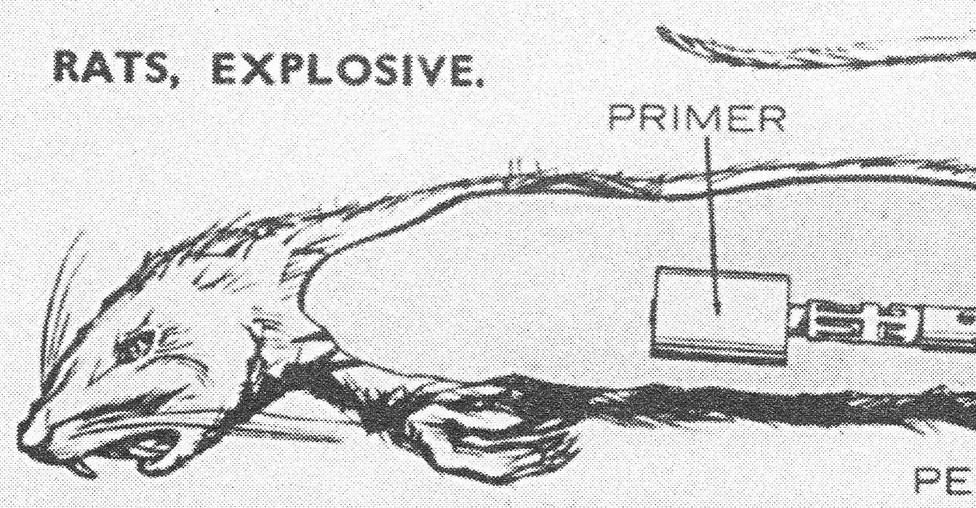
The Government was forced to back down. It offered Grindell Matthews £1,000 if he could show that his invention would stop a motorcycle petrol-engine. The inventor, now in France, retorted he was doing a deal with the French. Indeed, his associate there, Eugene Royer, filed a patent for a death ray around this time. That summer, Grindell Matthews made a Pathé film showing off the shiny death-ray machine and demonstrating it could kill a rodent at the flick of a switch.
The death ray fades
Yet, strangely, a finished weapon never materialised, either in France or back in Britain. Later the same year, and still famous, Grindell Matthews set off on a fundraising tour of the US. Again, however, he refused to explain or demonstrate how his death ray worked. Over the next few years, interest in his claim and offers of cash faded away.
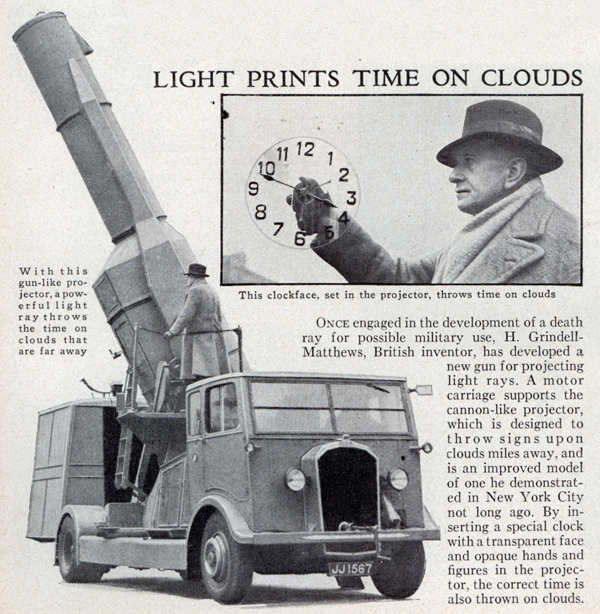
Then, on Christmas Eve 1930, Grindell Matthews was back in the headlines. Above the skies of London, festive shoppers could make out the words ‘Happy Christmas’ projected onto the clouds.
It was the outcome of his latest scheme: the Sky Projector.
This time his beam would not be killing things – but advertising them. Sadly for Grindell Matthews, it proved a commercial flop, and he was declared bankrupt in 1934. Between then and his death in 1941, he became a virtual recluse, locked away in a remote compound in Wales, still beavering away on new projects.
A smattering of failed attempts by other inventors, including Nikola Tesla, plus the introduction of nuclear weapons, meant that the death ray was to be forever confined to the pages of sci-fi novels and films.