WAR CULTURE - Nevinson's prints
In conjunction with a new exhibition opening at Osborne Samuel gallery, MHM looks at some of CRW Nevinson’s most celebrated war-time works of art.
Christopher Richard Wynne Nevinson was a noted British war artist, whose predilection for representing the mechanical nature of war set him apart from many of his wartime contemporaries. Having opted to join the Friend’s Ambulance Unit as a dedicated pacifist in 1914, Nevinson subsequently served with the Royal Army Medical Corps but was invalided out of the army in January 1916 suffering from rheumatic fever.
This was not however the end of his war. An exhibition of his paintings later that year in September brought him to the attention of the chief war propagandist Charles Masterman of the War Propaganda Bureau. Masterman successfully petitioned Nevinson to travel to the Western Front painting in an official capacity for the British government.
In spite of his known radicalism Nevinson eagerly accepted, and it is to Masterman's credit that Nevinson's work largely escaped censorship, although much of it would have appeared uncomfortable in official quarters.
Nevinson's work was stark in drawing the public's attention to the increasingly mechanised nature of modern warfare, far removed from the romantic artistry that often accompanied the early stages of the war, which generally depicted man fighting man (often in hand to hand combat). Nevinson made 148 prints; etchings, drypoints, mezzotints, and lithographs between 1916 and 1933. There is no doubt that his war experience greatly influenced his subject matter and he produced some of the most poignant images of war in printmaking history.
The Road from Arras to Baupaume
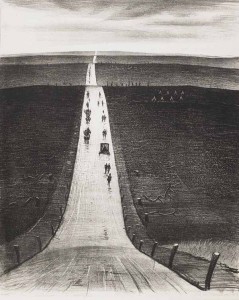
In 1919, soon after being demobbed from the British Army, Captain Samuel Davenport Charles happened upon this print of Nevinson’s ‘The Road from Arras to Bapaume’ at the Leicester Gallery in London where Nevinson held his first solo exhibition.
With Arras and his time on the Western Front fresh in his memory, the Captain purchased this haunting image of the area where he served. It would come to be a meaningful pictorial memento not only of his service, but also as a reminder of his bravery and survival at the Western Front, where so many sadly perished.
Swooping Down on a Taube
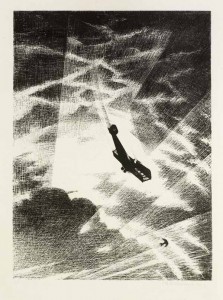
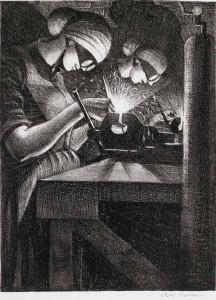
This is the sixth of Nevinson’s six prints, which show the process of building an aeroplane, from making parts, to assembly, and finally to flight. Nevinson took a particular interest in aerial warfare, devoting three prints to showing aircraft in flight.
In this image, a British plane takes a breathtaking dive towards a German Taube aircraft, set against a dramatically-lit sky. The German plane is recognisable by its curved, bird-like profile – taube is German for ‘dove.’
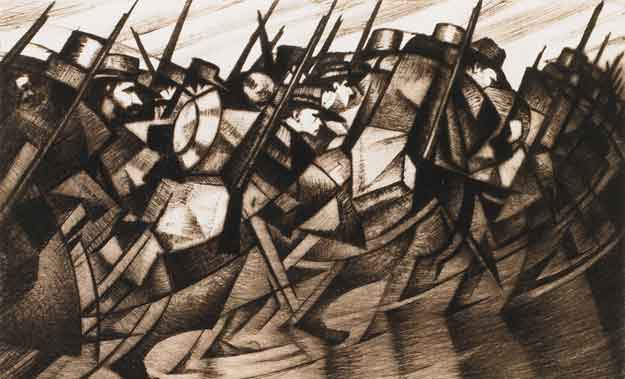
Returning to the Trenches
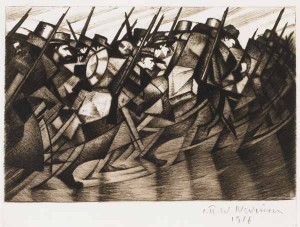
Now the Bayonets have Won Through
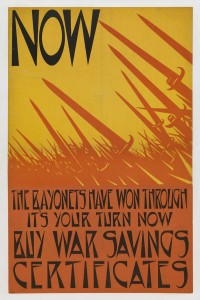
The remarkable design depicts massed fixed bayonets printed in orange against a bright yellow background. The bold design and the superimposition of the black stylised text against a field of fiery colour produce an arresting result.
Nevinson's design also highlights the optical disturbance associated with 'dazzle' effects. In poster terms, dazzle effects were employed to attract the eye against an increasingly hectic background of metropolitan life.
The cultural significance of Nevinson's poster cannot be overstated. Looking back over the artistic experimentation of the 20th century, the consistent recurrence of dazzle and strobe effects points to the power of this design as a major breakthrough.
Assembling Parts
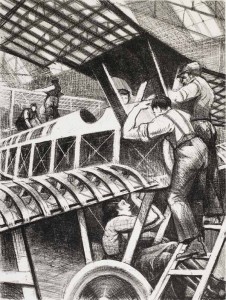
Acetylene Welder
A Group of Soldiers
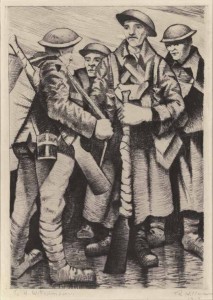
According to Major A N Lee, censor at General Headquarters, the image depicted ‘the type of man…not worth of the British Army,’ while another critic described the men portrayed as ‘a gang of loutish cretins.’ Nevinson stated that he had simply attempted to represent ‘the British working man’ accurately, and that the four men in the painting were men he had actually seen coming off the tube as they came back from France on leave. Nevinson described the scene thus: ‘the men were so unutterably wretched, their misery was so intense, that the result of it was mad laughter.’
The work was eventually allowed to hang in the exhibition after a dispute was resolved between the War Office and the Department of Information.
A Dawn
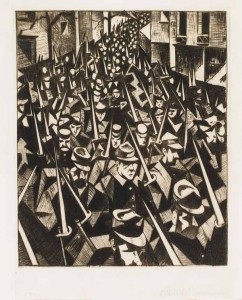
Always seeking a public platform for his art, Nevinson told the Daily Express in 1915, ‘Our Futurist technique is the only possible medium to express the crudeness, violence, and brutality of the emotions seen and felt on the present battlefields of Europe.’
But his experience as an ambulance driver in the First World War changed him, and in the paintings and drawings he made while serving at Dunkirk, and later when a volunteer in the Royal Army Medical Corps at the General Hospital at Wandsworth, the soldiers are reduced to a series of angular planes and grey colouring, losing their individuality and appearing almost like machines.
That Cursed Wood
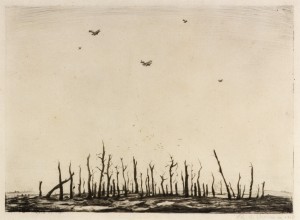
Down in the hollow there's the whole Brigade Camped in four groups: through twilight falling slow I hear a sound of mouth-organs, ill-played, And murmur of voices, gruff, confused, and low. Crouched among thistle-tufts I've watched the glow Of a blurred orange sunset flare and fade; And I'm content. To-morrow we must go To take some cursèd Wood ... O world God made!
Go Further: This exhibition coincides with the launch of CRW Nevinson: The Complete Prints, a new book compiled and written by Dr Jonathan Black, and co-published by Osborne Samuel and Lund Humphries Publishing. The exhibition will run at Osborne Samuel Gallery (23a Bruton Street, W1) from 25 September to 18 October 2014, and a selection of the prints will be shown at the annual New York Print Fair of the International Fine Print Dealers Association (5-9 November, Park Avenue Armory at 67th Street).