WAR ZONE - City of Terror: the Japanese takeover of Shanghai
Mark Felton revisits the nightmare of the Japanese takeover of foreign ‘concessions’ during World War II.
‘Obviously, there is nothing you can do with the forces at your disposal. I would suggest that you strike your colours,’ was the last communication Lieutenant Stephen Polkinghorn had with the British Embassy in Shanghai. Polkinghorn replaced the receiver in its cradle, his lip curling in disgust. He had just been advised to surrender HMS Peterel, the Royal Navy’s last remaining Yangtze River gunboat in mainland China, to the Japanese. She sat moored on the Huangpu River opposite the Bund, Shanghai’s glittering neoclassical ‘Million Dollar Mile’. It was early morning, 8 December 1941, and the word ‘surrender’ was not in Polkinghorn’s vocabulary. A Japanese gunboat moved in the distance, a signal lamp sending coded Morse to the riverbank, and a curl of smoke rose from the funnel of the huge Japanese cruiser Izumo moored close by. The Peterel had been protecting British trade on China’s rivers since 1927, but now she had been reduced to a floating communications station on the Huangpu, organising supplies to the Chinese Army. Her two 3-inch guns had been mothballed and her crew reduced from 55 to just 20 men.
‘Britain is at war with Japan’
Moored close by was an American gunboat, the USS Wake, also stripped of defensive weapons and most of her crew. Lieutenant Polkinghorn, the Peterel’s Royal Naval Reserve skipper, had been below when he received the final phone call from the embassy. The voice at the other end was terse and to the point: ‘The Japanese have bombed Pearl Harbor in Hawaii, and Britain is consequently at war with Japan!’ Polkinghorn was not surprised. ‘You can expect a visit from the Japanese at any time,’ continued the measured tones of the diplomat. Polkinghorn’s vessel represented the last regular British armed forces in Shanghai, and naval honour dictated that he could not surrender his ship without a gesture of defiance. Polkinghorn ordered: ‘Action stations!’ when a Japanese launch was seen approaching his vessel. Steel helmets were donned and two Lewis machine-guns were loaded, their circular ammo pans smacked into place, and the weapons cocked with a solid click. It was 4am, and close by the Wake was being boarded by the Japanese – her skipper, Lieutenant-Commander Columbus Smith, was still at his apartment ashore when his ship was captured. Apart from the Peterel and the Wake, there was precious little else with which to defend foreign Shanghai from the Japanese. The Royal Navy had long since withdrawn its cruisers to fight in the Atlantic and Mediterranean. The multi-national Shanghai Volunteer Corps (SVC), a British-led defence force formed in 1854, was told to stand down on 8 December 1941. The SVC represented the international character of Shanghai in the mid-20th century, with units as diverse as the kilted Shanghai Scottish to the Russian Regiment and Jewish Company.
A Russian doll
Shanghai itself was really three cities within one – like a Russian doll. The International Settlement, dominated by the British and American concessions, occupied the heart of the city, and, although not technically a colony of any nation, was firmly ruled by the Anglo-American municipal council. South of the Settlement was the French Concession, ruled directly from Hanoi in Indochina. Surrounding these two conjoined entities was the Chinese Municipality, governed at different times by warlords or the central government in Nanking. The Japanese, whose own concession consisted of the Hongkew District just north of the Bund, had occupied all of Chinese Shanghai in 1937 as they gobbled-up eastern China in great devastated chunks. It was only a matter of time before they swallowed up the sweet prize of foreign Shanghai as well. The British Government had declared the Settlement indefensible in 1940 and withdrawn the two regular infantry battalions that formed the garrison to Hong Kong. The Americans had followed suit shortly after. Over 8,000 defenceless British citizens continued to live and work in Shanghai, alongside nearly 2,000 Americans and the citizens of many other nations. There were also thousands of stateless White Russians who had fled the Russian Civil War as well as over 20,000 Jews who had escaped Nazi persecution to the only free port left open to them.
‘Get off my bloody ship’
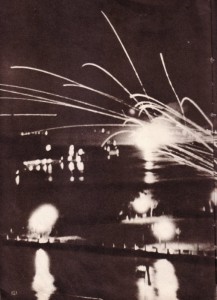
Onboard the Peterel, a small group of Japanese army officers, samurai swords at their sides, climbed the ladder onto the quarterdeck and saluted stiffly. Lieutenant Polkinghorn listened impatiently to their interpreter as the Japanese ordered the New Zealander to surrender his ship immediately or face the consequences. Polkinghorn drew himself up to his full height, stuck out his chin, and hissed ‘Get off my bloody ship!’ The astonished Japanese officers silently filed back into their launch, dumbfounded at the young officer’s suicidal boldness. Grim-faced, Polkinghorn’s two dozen ratings took cover behind sandbags piled in the gangways, the men manning the machine-guns staring intently at the grey bulk of the Izumo as the booming report of its massive guns echoed across a city that was just coming to life, rattling windows throughout the International Settlement. The Peterel was already rigged with scuttling charges, and Polkinghorn’s decision to put up a fight was necessary to buy enough time to send his ship to the bottom of the river. He cupped his hands to his mouth and yelled ‘Open fire!’ The chattering machine-guns blasted long lines of bullets at the monolithic structure of the Japanese cruiser, wounding several Japanese, but these were soon drowned out by the whoosh of shells throwing up giant geysers of dirty river water all around the tiny British ship. With a blinding flash and a deafening concussion the Peterel was struck, the ship heaving over hard against her cables, flames shooting into the air. Within minutes the whole superstructure was on fire, bodies littered the blood-soaked deck, and the cacophony of battle intermingled with the high-pitched screaming of the wounded and the copper-stench of blood. The Peterel lurched again and began to take on a startling list. ‘Abandon ship, abandon ship!’ yelled Polkinghorn as the vessel threatened to capsize. Men plunged into the brown river, casting away their tin helmets as they dove in. Polkinghorn wrenched off his binoculars and dived in after his men.
‘Mr Trees’
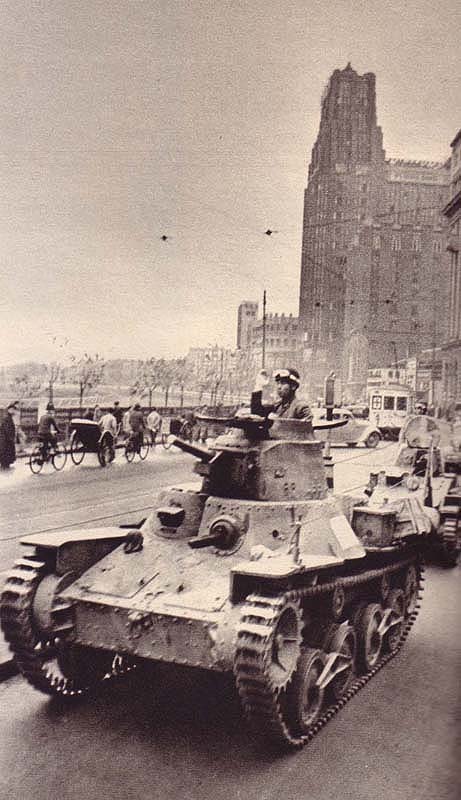
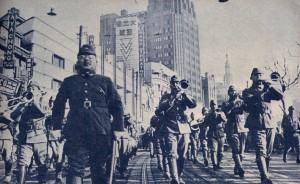
Apart from this one small battle, the Japanese takeover of Shanghai was remarkably bloodless and terrifyingly quick. The British lost five killed and 14 taken prisoner. One man escaped. Petty Officer James Cuming, a radio operator, was ashore when the Japanese attacked, and he joined the Chinese resistance. For three-and-a-half-years, Cuming, using the alias ‘Mr. Trees’, played a cat-and-mouse game with Japanese intelligence, but he was never caught. Lieutenant Polkinghorn was awarded the Distinguished Service Cross after the war. At the north end of the Bund, the British-built Garden Bridge spans Suzhou Creek with the imposing edifice of Shanghai Mansions towering behind. Across the iron bridge, where since 1937 Japanese sentries had controlled access to the Settlement from Hongkew, Japanese Type 95 Ha-Go light tanks and Vickers-Crossley armoured cars (ironically British-built) trundled noisily across, followed by trucks flying the Rising Sun flag. Loaded aboard were the men of the 746-strong Shanghai Special Naval Landing Force – Japanese marines. The tanks and trucks moved along the Bund, while others drove up Nanking Road, Shanghai’s main shopping thoroughfare, towards the Race Course (today’s People’s Square), dominated by the tallest building in Shanghai, the dark-brown Park Hotel. Chinese rickshaw pullers and coolies scattered at the approach of the ‘shrimp barbarians’, as the Chinese called the Japanese. Wearing blue landing rig with army helmets and webbing, the Japanese troops toted long Arisaka rifles with fixed bayonets. Several parties of Japanese marines on foot, accompanied by Japanese civilians wearing white Rising Sun armbands, entered the many foreign-owned banks and insurance buildings that lined the Bund and the streets behind, some plastering notices onto their elaborate wrought-iron gates proclaiming that these premises were now under Japanese military control.
‘Not exactly dogs of war’
Shanghai fell under the control of Lieutenant-General Shigeru Sawada, commander of the 13th Army. Headquartered in Shanghai, Sawada’s four infantry divisions controlled a huge swathe of territory astride the Yangtze River towards Nanking. The 11th Independent Mixed Brigade provided the Japanese garrison in Shanghai, while the naval base was the responsibility of the Imperial Navy. British resistance to the Japanese takeover once the Peterel had been sunk and the SVC disarmed revolved around Oriental Mission (OM), an SOE sabotage and intelligence-gathering group. OM’s original orders were to keep an eye on Shanghai’s Nazis, and to plan an attack on the Fascist Italian gunboat Eritrea moored on the Bund. This was to prove rather a tall order, for OM consisted of seven middle-aged Britons led by 55-year-old wine merchant William Gande. The other members were two company managers, a surveyor, a stockbroker, and 65-year-old William Clarke, former Deputy-Commissioner of the Shanghai Municipal Police: not exactly dogs of war. OM Shanghai achieved nothing and was soon rounded up by the Kempeitai, Japan’s much-feared military police, and horribly tortured at Bridge House. In a truly astounding mistake, the British had remitted £5,000 of operating funds through HSBC on the Bund, using Gande’s name. When the Japanese liquidated Allied assets, this transfer of funds was discovered and OM Shanghai swiftly eliminated.
‘The Japanese were showing their teeth’
The round-ups of foreigners began on 5 November 1942 when the Kempeitai launched early morning raids, arresting 243 Britons, 65 Americans, 20 Dutch, and some other foreign nationals, totalling 350 men in all. Labelled ‘Prominent Citizens’, they were hauled off to Haiphong Road Camp, run by the Imperial Japanese Army. ‘The Japanese were showing their teeth,’ recalled arrested British reporter Ralph Shaw, ‘and, from their record of cruelty in China, we knew that many of us were going to suffer indescribable ill-treatment.’ Bridge House, a large white apartment block just across Garden Bridge, became the main Kempeitai interrogation centre, and by February 1942 the Japanese had arrested many foreign journalists, businessmen, and police officers. Some were held for months; beaten, whipped, given the water torture, electrocuted, and starved. The Japanese subjected American reporter John B Powell to ‘atrocious assaults, beating him unmercifully,’ recalled Shaw. H G W Woodhead, outspoken British editor of Oriental Affairs, who had attacked the Japanese for their earlier outrages in China, almost died. Sir Frederick Maze, former inspector-general of Chinese Customs was tortured for four weeks before being released without charge. Anyone even remotely suspected of being ‘anti-Japanese’ was arrested and tortured. Fear of a knock on the door in the middle of the night was literal.
‘Every time you got an illness it spread’
The Japanese issued regulations to make life for Allied nationals as unpleasant as possible. Access to bank accounts was severely restricted, and Allied citizens were required to purchase a red armband that was emblazoned with a letter denoting their nationality (‘B’ for British, ‘A’ for American, ‘N’ for Dutch (Netherlander), etc). Many foreigners were ordered to remain at their jobs running Shanghai’s police and essential services. But Allied citizens were forthwith forbidden from entering theatres, cinemas, dance halls, nightclubs, the Canidrome in the French Concession, and the Race Course. They were also ordered to surrender all radios, cameras, binoculars, and telescopes. Some Allied citizens were repatriated from Shanghai, but the majority faced over three years of imprisonment under deteriorating conditions. Between January and July 1943 the Japanese rounded up 7,600 Allied men, women, and children and sent them to camps in Shanghai or upriver to Yangchow (now Yangzhou). They were forced-marched through downtown Shanghai to humiliate them in front of the Chinese. Single men were sent across the river to Pootung Camp, a dilapidated former British-American Tobacco warehouse. The remainder went to seven camps in the city, including the Lunghwa Camp, where a young J G Ballard was one of 2,000 inmates and later wrote about his experiences in Empire of the Sun. ‘Almost everyone who had diabetes died,’ recalled Ronald Calder, another child inmate. ‘Every time you got an illness it spread and there was never a chance to get well again.’ Moira Chisholm, who was interned in Chapei Camp aged 9 in 1943, recalled the violence. ‘Adults were beaten up all the time and we got quite blasé about seeing this.’ Chapei consisted of two 3-storey blocks and a chemical factory on a 15-acre site into which 1,500 internees were crammed.
‘You could get beaten for moving’
Food in the camps was always short, they were overcrowded with minimal washing facilities, and brutality was ever-present. Disease was the biggest killer, the elderly and the young being particularly susceptible. Ash Camp, a former British Army barracks named for its black ash pathways, housed over 500 internees in family rooms or dormitories that flooded during heavy rain. The Japanese enforced strict discipline upon the internees, particularly during tenko (roll call). ‘If you moved or went in your room or had to go to the bathroom or anything, it didn’t matter if you were a little baby or a grown-up, you didn’t dare do that because you could get slapped around or beaten for moving,’ said Rachel Bosebury Beck. Before the nightmare of Japanese occupation came to an end in August 1945, over 250 British citizens had perished in the Shanghai internment camps. ‘You had this constant fear that you might have been shot,’ recalled Bosebury Beck, ‘picked up, tortured, anytime. That was a fear, and it’s terrible.’
Mark Felton’s Japan’s Gestapo: murder, mayhem and torture in wartime Asia (Pen & Sword Books, 2009) and Children of the Camps: Japan’s forgotten victims (Pen & Sword Books, 2011) contain several chapters about Japanese-occupied Shanghai.
David Flitham discovers an off-shore treasure-trove of British military heritage. Situated some 48km west-south-west of Land’s End, the Isles of Scilly are…
Stephen Miles explores British fortifications erected in preparation for a war that never happened. On 5 September 1800, French forces surrendered Malta…
David Tattersfield of the Western Front Association assesses a failed attack on a crucial German salient during the Battle of the Somme.
This website uses cookies
Select which cookies to opt-in to via the checkboxes below; our website uses cookies to examine site traffic and user activity while on our site, for marketing, and to provide social media functionality. More details...
Cookie settings
We use cookies to enhance your browsing experience, serve personalized ads or content, and analyze our traffic. By clicking "Accept All", you consent to our use of cookies. More details...