WEAPONS SYSTEMS - The flintlock musket
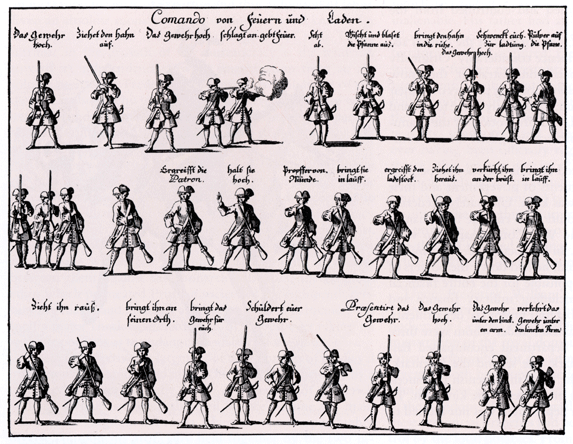
Massed Musketry was central to 18th-century tactics. Infantry training - represented in manuals like this one used in our Malplaquet feature - involved breaking down the process of loading, aiming, and firing into a series of micro-movements that would become automatic, even in the chaos and terror of battle.
Though the quality of flintlocks improved during the 18th century – notably with the introduction of the ‘Brown Bess’ in 1722 – the weapon carried by Marlborough’s men in Flanders was essentially the same as that carried by Wellington’s in the Peninsula a century later.
Compared with the matchlock of the mid 17th century, the flintlock had several advantages. A trigger mechanism in which a flint was used to strike sparks in an iron pan filled with powder was more reliable, especially in the wet, than one dependent upon a slow-burning match. The combination of ball and powder-charge in the form of a cartridge speeded up loading. The British also had the advantage of a heavier ball, which increased accuracy, velocity, and stopping-power. And the provision of a socket bayonet meant that the musket doubled as a spear, making the musketeer an all-purpose infantryman, no longer dependent on the protection of cumbersome blocs of pikemen.
Still, with a rate of fire of only about two rounds a minute, and an effective range of well under 100 yards (even if a ball might carry as far as 250 or more), disciplined volley-firing was critical to battlefield effectiveness. Ragged fire at ranges above 100 yards was virtually useless; controlled fire at ranges below 50 could destroy an opposing battalion in a matter of minutes.